Mold Remediation Arlington TX | Find It, Remove It, Keep It Gone
Arlington’s heat and humidity make mold a fast-moving problem after any water event. We contain it, remove it completely, and verify with post-clearance testing. Call any hour.
(817) 231-8660Request Mold Assessment
We respond within the hour, every day of the year.
Quick Answer
Mold remediation in Arlington, TX typically takes 1 to 5 days depending on the size of the affected area. Mold can begin colonizing wet drywall and wood within 24 to 48 hours of a water event. In Arlington’s summer heat and humidity, that window is even shorter. Full clearance testing confirms the job is done.
Mold remediation in Arlington, Texas is a response to what happens when water damage is not caught in time — or when it is hidden inside walls, under floors, or in crawl spaces where homeowners never look. We find mold that has been growing unseen, remove it completely, and verify the results with post-clearance air quality testing. This page explains the full process, the health risks, and why Arlington’s climate accelerates the problem.
How Fast Mold Grows After Water Damage in Arlington
The timeline is shorter than most people think. Mold spores are always present in indoor air. What they need to germinate is moisture and a food source — and drywall paper, wood framing, and insulation are all adequate food sources. Under typical Arlington summer conditions (temperatures above 85 degrees, humidity above 60 percent), active mold growth can begin within 24 to 48 hours of a water event. In enclosed spaces like wall cavities and under-slab areas, the conditions are even more favorable.
By 72 hours, visible mold colonies can be present on drywall and wood surfaces. By one week, mold has typically spread well beyond the visible area and penetrated deep into porous materials. Standard cleaning does not remove mold that has penetrated into the substrate of drywall or wood — those materials must be physically removed. That is why the timeline between a water event and when you call for remediation matters so much.
Health Risks of Mold in Arlington Homes
Mold exposure causes a range of health effects depending on the species, the concentration, and the sensitivity of the people in the home. Common symptoms include nasal congestion, throat irritation, coughing, wheezing, and eye irritation. People with asthma or compromised immune systems can experience more serious reactions. Children and the elderly are particularly vulnerable.
The EPA recommends that mold patches larger than 10 square feet be handled by professionals. That is a relatively small area — about the size of a standard window. If you can see mold on more than a small section of wall or ceiling, the real extent of the growth is almost certainly larger than what is visible. The EPA’s mold remediation guidelines provide a solid baseline for understanding when professional intervention is needed.
Why Arlington’s Climate Accelerates Mold
Tarrant County averages about 37 inches of annual rainfall with most falling in spring and fall. Summer temperatures regularly exceed 100 degrees. That combination creates extreme moisture-then-heat cycling that pushes moisture deep into building materials during rain events and then traps it as surfaces heat up. Pier-and-beam homes common in older parts of Arlington near the UTA campus are especially vulnerable because crawl space ventilation is often inadequate for the climate load.
Arlington’s Blackland Prairie clay soil also retains moisture for weeks after rain events, keeping the soil around and under slab foundations consistently damp. That soil moisture migrates upward into concrete slabs and then into wall systems through capillary action. It is a slow, invisible process that can sustain mold growth in a home that has not had an obvious water event in months.
Our Mold Remediation Process
We start with a full inspection using moisture meters and, where appropriate, borescopes to check inside wall cavities without destructive opening. Visible mold is photographed and mapped. We establish containment using polyethylene sheeting and negative air pressure with HEPA-filtered air scrubbers to prevent spores from spreading to unaffected areas of the home during removal work.
Affected materials — drywall, insulation, wood where mold has penetrated below the surface — are removed, bagged, and disposed of properly. Remaining structural surfaces are treated with EPA-registered antimicrobial agents. After treatment, HEPA vacuuming removes residual spores. We then set drying equipment and monitor until target moisture levels are reached. Finally, air quality testing confirms spore counts are within normal range before we clear the space.
Why DIY Mold Removal Fails
Bleach does not kill mold in porous materials — it discolors the surface while leaving the root structure (hyphae) alive inside the substrate. Without containment, scrubbing mold releases millions of spores into the air and spreads the problem to other rooms through your HVAC system. And without air testing, you have no way to confirm the remediation was successful. Insurance claims for mold also typically require professional documentation, moisture logs, and clearance test results. A DIY cleanup that leaves moisture behind almost always fails an adjuster’s review.
If the mold followed a flood or major water event, also read our flood cleanup page and our water damage restoration page to understand the full scope of what your property may need.
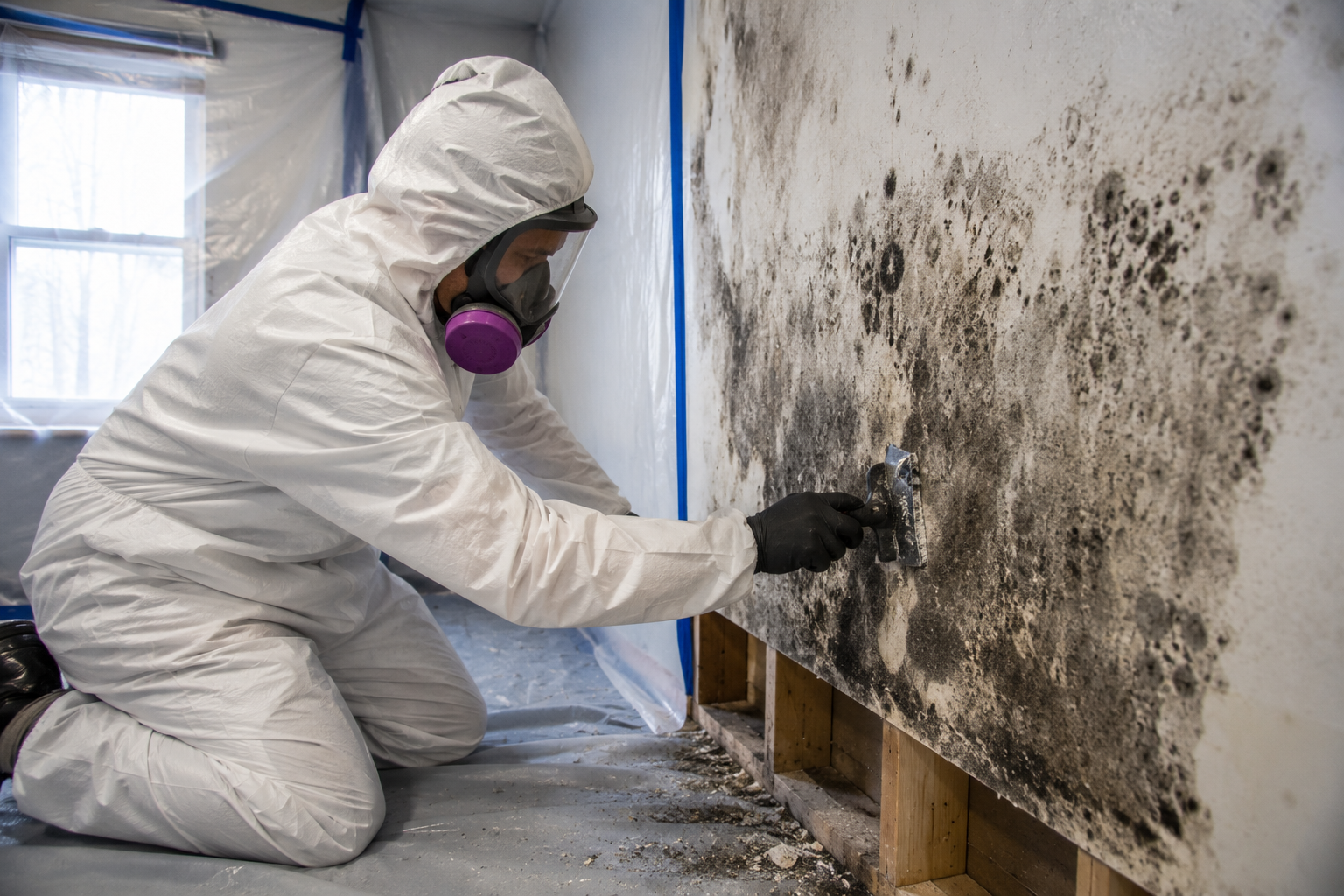
Mold Growth Timeline
- 0-24 hours: Spores present, conditions forming
- 24-48 hours: Germination begins on wet surfaces
- 48-72 hours: Visible colonies forming
- 1 week: Growth spreads beyond visible area
- 2+ weeks: Structural damage, HVAC contamination risk
Mold-Prone Locations in Arlington Homes
- Crawl spaces in pier-and-beam homes
- Inside wall cavities near slab perimeter
- Behind kitchen and bath tile
- Under carpet in below-grade areas
- Attic sheathing after roof leaks
- HVAC ducts and air handlers
Frequently Asked Questions
Common indicators are a musty smell that does not go away, visible discoloration at baseboard level, staining on drywall that returns after painting, or residents experiencing unexplained allergy or respiratory symptoms. We can inspect wall cavities with moisture meters and borescopes without opening every wall. Call us if anything seems off.
It depends on what caused the mold. If mold grew as a result of a covered water loss — such as a sudden pipe burst — many Texas policies will cover at least a portion of the remediation. Mold resulting from long-term neglect or gradual leaks is typically excluded. Documentation of the original water event and timeline is critical.
Yes. Mold growing inside wall cavities, under flooring, or in crawl spaces releases spores into your indoor air without any visible surface growth. If you or family members are experiencing persistent respiratory symptoms, fatigue, or headaches that improve when you leave the house, hidden mold should be investigated.
Mold will come back if the moisture source is not eliminated. Our process addresses both the mold and the moisture conditions that allowed it to grow. If you have an ongoing source of water intrusion — a drainage problem, an unresolved pipe issue, inadequate crawl space vapor barriers — that needs to be fixed or the problem will recur regardless of how thorough the remediation was.
Request a Free Mold Assessment
Describe your situation and we will call you back within minutes.