
Slab Leaks in Arlington TX — Why Blackland Prairie Clay Makes This City One of the Worst in Texas
 By Adam Wilson, Arlington TX Water Damage
Quick Answer
Slab leaks are unusually common in Arlington TX because the city sits on Blackland Prairie clay — one of the most expansive soils in the United States. This clay swells when wet and shrinks when dry, creating constant movement under slab foundations that stresses embedded plumbing lines. The cycle of wet North Texas springs and dry summers accelerates the damage. Signs include warm floor spots, sound of running water with all fixtures off, and unexplained water bill increases.
Slab leaks are a fact of life in Arlington, Texas in a way they simply are not in cities built on different soil types. Plumbers who work the Tarrant County market know it. Restoration contractors who handle the resulting water damage know it. The homeowners who find a warm spot on their tile floor on a Tuesday morning and end up with a six-figure insurance claim know it too, eventually.
The reason comes down to what is underneath every slab-on-grade home in Arlington — and in most of the city, that is Blackland Prairie clay. Understanding what that soil does to your foundation and your plumbing is not an academic exercise. It is the difference between catching a slab leak early and discovering it three months after the fact when mold has established itself in the wall cavities along the leak path.
What Blackland Prairie Clay Actually Does
Blackland Prairie clay is a vertisol — a soil type classified by its high shrink-swell capacity. In practical terms, this means the soil expands significantly when it absorbs water and contracts significantly when it dries out. The volume change is not trivial. In Arlington’s climate — wet springs followed by dry, intensely hot summers — the clay under a residential slab can change volume by several percent within a single season.
That movement translates directly to the concrete slab above it. The slab flexes, shifts, and in many cases develops differential settlement, where one section of the foundation moves more than another. The plumbing lines that run through or under that slab are copper or galvanized steel, neither of which tolerates repetitive flexing well. Over years of seasonal clay movement, elbows crack, straight runs develop pinhole leaks, and joints that were properly sealed at installation slowly separate.
This is not a construction defect. It is what happens to plumbing in expansive clay soil over time. The homes most affected are typically 20 to 40 years old — new enough to be on a slab rather than pier-and-beam, but old enough that the cumulative cycles of soil movement have added up.
How a Slab Leak Damages Your Home
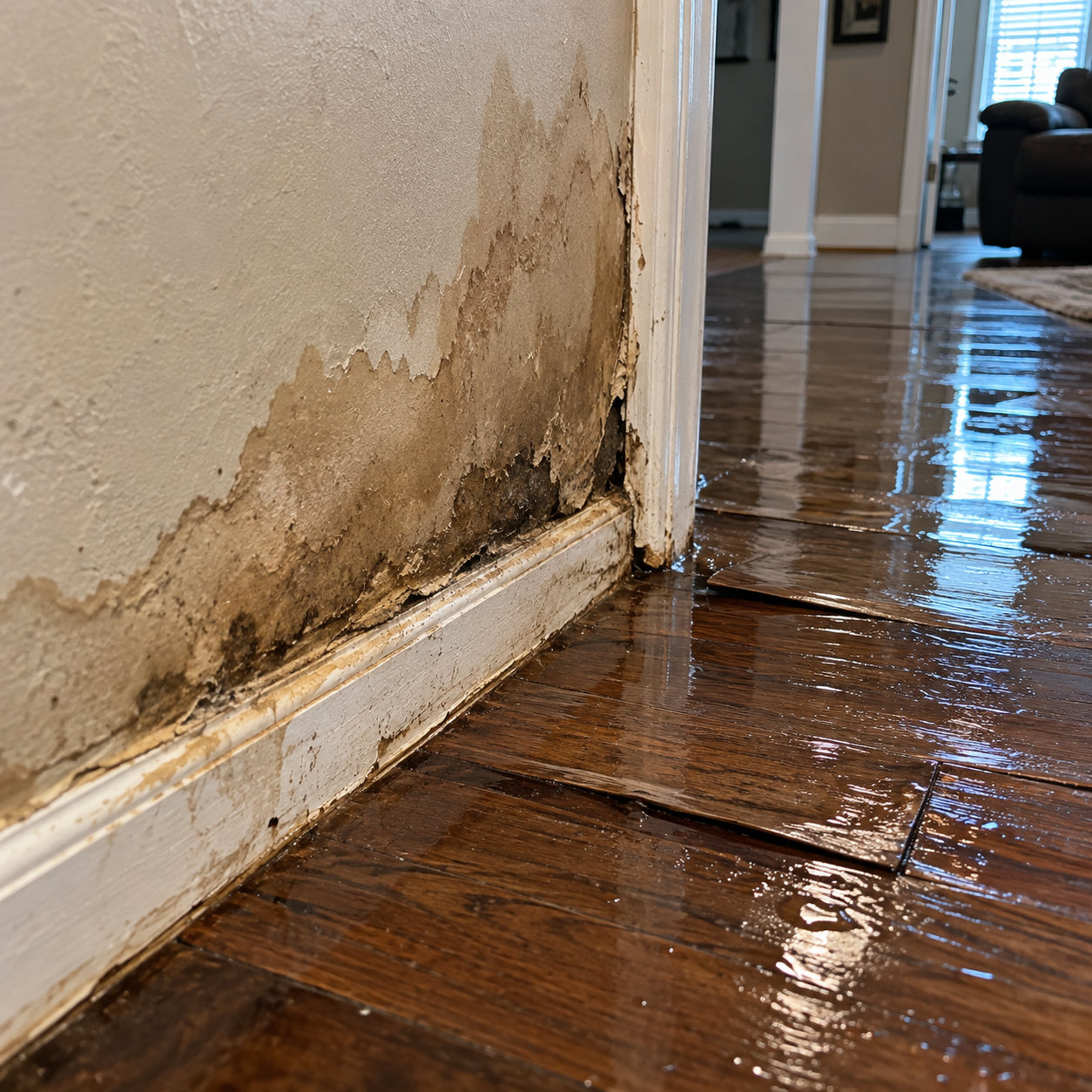
The insidious thing about a slab leak is how slowly and invisibly it operates. A pinhole leak in a hot water line under a slab does not produce a visible puddle. It produces warm, pressurized water that migrates horizontally through the concrete matrix and upward through the slab surface. By the time any visible sign appears — a warm spot underfoot, a damp area near a baseboard, a tile that starts to loosen — the water has been traveling for weeks. The path from the leak point to the visible sign can be 10 to 20 feet or more.
That migration path saturates everything it touches. Subfloor materials absorb moisture. The bottom plates of interior walls wick it upward into the framing. Drywall at floor level begins softening. In Arlington’s summer heat, mold has everything it needs to establish in those wall cavities within days of the moisture arriving.
Our water damage restoration page covers the full scope of what remediation looks like after a slab leak — but the key point is that the water damage from a slab leak is almost always larger than it appears, and thermal imaging is the only reliable way to find the full extent.
Warning Signs of a Slab Leak in an Arlington Home
Know these and check for them. A warm or hot area on the floor — particularly tile or hardwood — over a location where no heating appliance or duct runs beneath is the most common early indicator of a hot water line leak. The sound of running water when every fixture in the house is off is another. A water bill that increases by $30 to $80 or more without a change in household usage is a strong signal, even in the absence of any other visible sign.
Later-stage indicators include floor tiles that crack or pop loose along a line, drywall near the floor that softens or discolors, a musty odor at floor level, and in some cases the foundation itself cracking or shifting in ways that cause doors and windows to stick. By the time you are seeing those signs, the water damage is significant and mold is likely present. See our post on signs of hidden water damage for the full list.
What to Do If You Suspect a Slab Leak
Do not ignore it and do not try to diagnose it yourself. Call a licensed plumber for leak detection first — they use acoustic equipment and pressure testing to locate the leak without opening the slab unnecessarily. Once the leak is located and repaired, call us for a moisture assessment. We will use thermal imaging and moisture meters to map the full extent of water migration, which the plumber’s repair does not address. The plumber fixes the pipe. We fix the damage the leak caused.
Document everything with photographs before any work begins and notify your insurance company. Texas homeowners insurance typically covers the water damage from a sudden slab leak — the damaged flooring, drywall, and framing — but usually does not cover the pipe repair itself. Getting both calls made early protects your claim.
Arlington-specific note: Homes built between 1975 and 1995 in the central and southern parts of the city — the areas that developed rapidly during Arlington’s growth period — are the most common sources of slab leak calls we receive. If your home is in that age range and you have not had your plumbing pressure-tested, it is worth doing before a leak finds you.
Frequently Asked Questions
Slab leaks are unusually common in Arlington because the city sits on Blackland Prairie clay — one of the most expansive soils in the United States. This clay swells when wet and shrinks when dry, creating constant movement under slab foundations that stresses embedded plumbing lines over time. The cycle of wet North Texas springs and dry summers accelerates the damage to copper and galvanized steel plumbing.
Warning signs include warm or hot spots on the floor over a hot water line, the sound of running water when all fixtures are off, unexplained water bill increases of $30 or more per month, floor tiles cracking or popping loose along a line, drywall softening near the floor, and musty odor at floor level. Later-stage signs include foundation cracks and doors or windows that stick from differential settlement.
Texas homeowners insurance typically covers the water damage caused by a sudden and accidental slab leak — flooring, drywall, and structural materials — but usually does not cover the pipe repair itself or the cost of accessing it through the slab. Coverage depends on how quickly the leak was discovered and whether the insurer considers it sudden and accidental versus a slow leak from neglect.
Slab leaks can go undetected for weeks to months, depending on the leak rate and the path the water takes through the concrete. Low-pressure pinhole leaks in cold water lines are especially hard to detect because the water does not produce a warm floor spot. Some slab leaks are only discovered when mold appears at floor level or when a plumber pressure-tests the system during an unrelated service call.
Request a Moisture Assessment
Fill out the form and we will call you back within minutes.